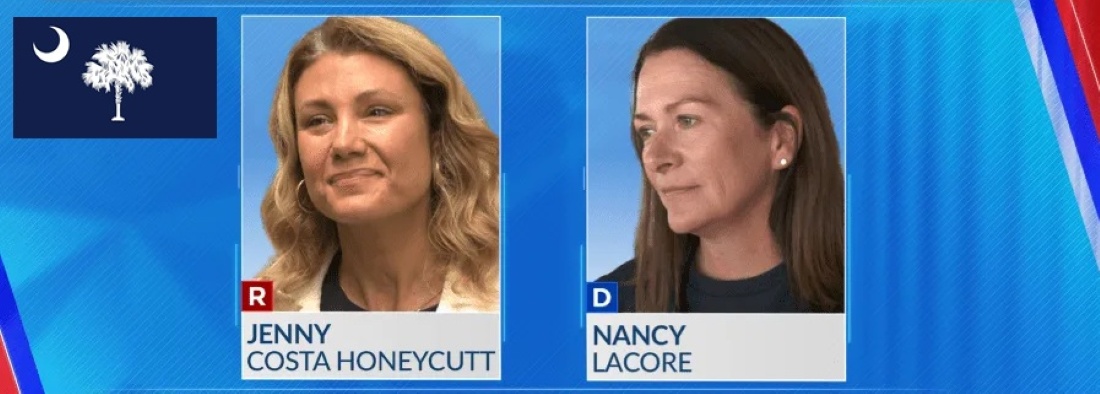
Democratic nominee Nancy Lacore’s campaign for South Carolina’s 1st Congressional District rests almost entirely on a single narrative: a decorated three-star admiral, dismissed without explanation, decides to keep serving her country through elected office instead of retirement. It’s a compelling story, and Democrats have built an entire recruitment strategy around candidates like her. But it raises questions that deserve direct answers before voters cast a ballot.
Would Nancy Lacore be running for Congress at all if Pete Hegseth hadn’t fired her?
Lacore is a native of Albany, New York. Her Navy career took her everywhere from San Diego to Naples to Djibouti but not, until recently, to South Carolina. Her Republican opponent, Jenny Costa Honeycutt, was born and raised in the district she’s asking voters to elect her to represent. That’s not a disqualifying fact for Lacore on its own but paired with the timing of Lacore’s move and her campaign launch, it sharpens the question of whether this candidacy reflects a genuine commitment to this district or a national party’s search for a sympathetic face for its case against the Pentagon purges.
The following questions are designed to probe that distinction.
Ten Questions for Nancy Lacore
- You’ve said you were removed “without cause,” but Secretary Hegseth’s Pentagon purge has been characterized as part of a broader Trump administration effort described as Pentagon reform. Do you have any documentation from the Navy or DoD showing the dismissal was procedurally improper, or was without cause as you have repeatedly characterized it?
- You’ve described the purge as sending a message that career service members “are not wanted” in the armed forces. Isn’t that a significant leap from your own removal to a claim about the administration’s intent toward the entire uniformed military?
- You launched your congressional campaign about five months after leaving the Pentagon. Given the traditional norm of separating recently serving officers from partisan politics, why should voters see this as principled public service rather than a fast pivot to capitalize on a grievance?
- Groups like VoteVets and EMILYs List endorsed your campaign almost immediately. How much of your campaign infrastructure and messaging was built by national Democratic groups rather than organically by you and Lowcountry voters?
- Given how recently you moved into the district (October 2025) relative to your campaign announcement (January 2026), what is your substantive record of civic or community involvement in the 1st congressional district of South Carolina prior to becoming a candidate, beyond your military biography?
- If they win back the majority in the House this November, Democrats have indicated they would attempt to increase the number of justices on the U.S. Supreme Court. If elected, would you support or oppose increasing the number of Supreme Court justices?
- You say you support ‘reproductive rights’. Do you support any restrictions on abortion, at any point in a pregnancy? If so, where’s the line, and why there?
- You’ve cited your own choice of when to have children as central to your career success. Does that mean you support elective abortion at any point up to birth, since ‘choosing when’ implies no gestational limit? If there is a limit for you personally, what is it?
- Do you support taxpayer funding for abortion, including for constituents who are morally opposed to it?
- Your opponent, Jenny Costa Honeycutt, has a multi-year record on Charleston County Council. What comparable record of constituent service or local governance can you point to that would reassure voters you understand the district beyond your national security credentials?
The Lacore campaign has not answered repeated emails asking for Nancy’s position on expanding the Supreme Court. Labeling fair questions as “Republican talking points” is an unacceptable deceptive tactic. The ten questions above are a knock on the door. There’s so much that needs to be uncovered about Nancy Lacore. Beneath the “I’m not done serving” façade might be nothing more than the desire for vengeance.
Lacore’s campaign wants this race to be a referendum on Secretary of Defense Pete Hegseth and President Donald Trump. It isn’t. It’s a referendum on her, on whether a candidacy built almost entirely on the manner of her firing, and imported from outside the district and state, can survive contact with questions about substance, residency, and record. Strip away the admiral’s stars and the “wasn’t done serving” line, and what’s left is a candidate born and raised a thousand miles from the district she wants to represent, who moved in on the eve of a campaign, has no local governing record to speak of, and has yet to offer a policy agenda that amounts to more than opposition to the administration that removed her.
Jenny Costa Honeycutt, by contrast, is a Lowcountry native who has spent years on Charleston County Council answering to these same voters on the issues that actually govern their daily lives. Voters in the 1st congressional district of South Carolina aren’t obligated to reward a well-credentialed newcomer’s grievance, however sympathetic, with a seat in Congress. Before November, Lacore owes the district more than a biography. She owes it answers.