Deploying Federal Troops and Federalizing State National Guard Units
There has been considerable criticism from Democrats regarding President Trump’s actions to deploy federal troops into various U.S. cities. They also argue that the process of federalizing state National Guard units and sending them to other states is illegal. Furthermore, they maintain that dispatching the National Guard into cities to assist with policing efforts is unconstitutional. However, these claims are not accurate.
Throughout history, United States Presidents have routinely authorized the deployment of troops and the National Guard to states and cities in order to address violence and restore order. The following is a summary of some presidential deployments, all of which were conducted in accordance with legal and constitutional principles. President Trump’s utilization of his executive authority to deploy U.S. Troops and the National Guard in support of ICE agents and to assist local law enforcement in apprehending violent criminals aligns with established precedents for such actions by previous administrations.
Examples of Comprehensive Presidential Deployments
1943 – Detroit, Michigan (June 1943)
President: Franklin D. Roosevelt
A large, racially driven race riot erupted in Detroit (several days of violence, dozens killed). City and state asked for federal help. FDR invoked federal authority and ordered federal troops (Army) into Detroit to restore order; roughly 6,000 federal troops were used.
1957 – Little Rock, Arkansas (Central High School) (Sept 1957)
President: Dwight D. Eisenhower
Arkansas Governor Orval Faubus used the state Guard to block school desegregation. Eisenhower federalized the Arkansas National Guard (removed them from state control) and sent elements of the U.S. Army to enforce a federal court order and protect the Little Rock Nine.
1962 – Oxford / University of Mississippi (Ole Miss), Mississippi (Sept 1962)
President: John F. Kennedy
Violent riots as James Meredith attempted to enroll. Kennedy federalized the Mississippi National Guard and sent federal troops to enforce federal court orders and secure campus integration.
1963 – Tuscaloosa / University of Alabama, Alabama (June 1963)
President: John F. Kennedy
Governor George Wallace attempted to block integration (“stand in the schoolhouse door”). Kennedy federalized the Alabama National Guard to enforce the court order and assure integration.
1965 – Selma → Montgomery, Alabama (civil-rights marches) (March 1965)
President: Lyndon B. Johnson
After violent suppression of marchers (e.g., “Bloody Sunday”), Johnson federalized the Alabama National Guard and ordered federal forces to ensure the protection of the officially sanctioned march from Selma to Montgomery. This ensured marchers’ safe passage and enforcement of a federal court order.
1967 – Detroit, Michigan (Long, large riot) (July 1967)
President: Lyndon B. Johnson
Massive urban rebellion (the 1967 “Detroit riot” / “rebellion”). Michigan requested federal help; Johnson federalized the Michigan National Guard and sent federal troops (including airborne divisions) to restore order.
1968 – Widespread riots after assassination of Dr. Martin Luther King Jr. (April 1968)
President: Lyndon B. Johnson
Following MLK’s assassination there were large riots and civil disorder in many cities. The federal government deployed federal troops (and federalized Guard units in some places) to help restore order in several cities (Washington, D.C.; Chicago, Baltimore and others).
1970 – U.S. Postal Strike (began in New York City; spread nationwide) (March 1970)
President: Richard Nixon
An illegal nationwide postal workers’ strike began in New York and spread to many cities, disrupting mail and federal services. Nixon ordered U.S. Armed Forces personnel and National Guard units into cities (notably New York) to attempt to process and deliver mail and keep the mail system functioning. (This was direct presidential use of federal forces to respond to a domestic disruption of federal services.)
1989 – United States Virgin Islands after Hurricane Hugo (Sept 1989)
President: George H. W. Bush
After Hurricane Hugo devastated the U.S. Virgin Islands, looting and lawlessness overwhelmed local capacity. The Governor requested federal help; President Bush authorized federal troops (Army, MP units, federal marshals, FBI) — an operation (Operation Hawkeye) — to restore order and support recovery.
1992 – Los Angeles, California (Rodney King verdict riots) (May 1992)
President: George H. W. Bush
Massive, multi-day riots (looting, arson, violence) after the acquittal of officers involved in the Rodney King beating. At the state and city’s request, President Bush federalized the California National Guard (and placed federal troops on standby and committed federal units) to help restore order.
These examples include using federal troops for mail delivery, school desegregation in Arkansas and Alabama, and restoring law and order during uprisings or disasters like hurricanes. The question is how these past presidential deployments of federal troops and the National Guard compare to what Trump has done in 2025.
President Trump
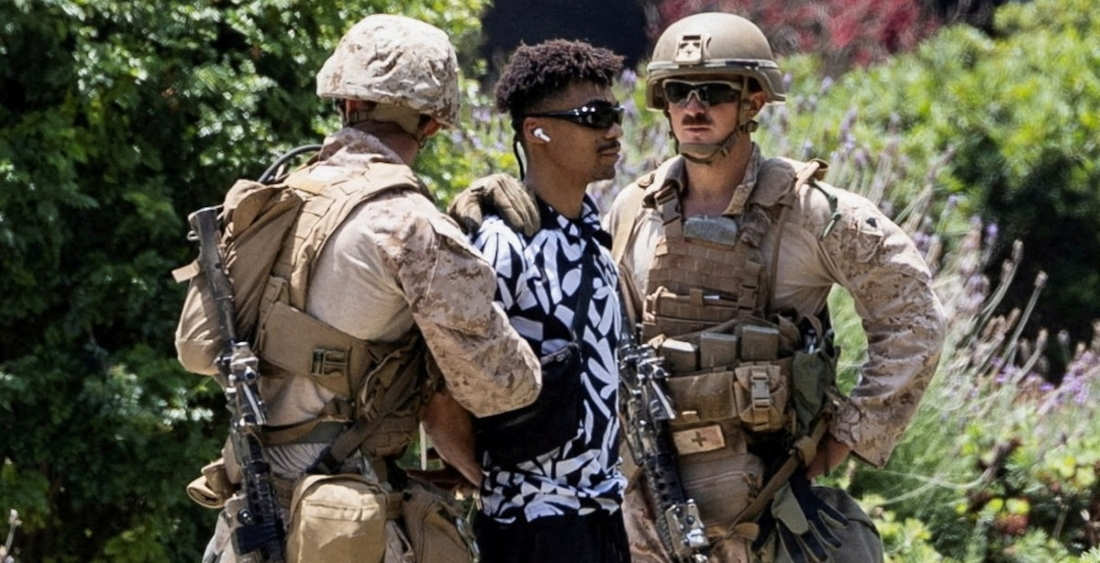
In 2025, President Trump took decisive steps to restore order in parts of the country where local leaders had failed to maintain public safety. In Los Angeles, months of escalating protests, property destruction, and open defiance of federal immigration law pushed the administration to federalize the California National Guard and deploy additional Marines to stabilize the situation. While California’s governor objected, the president acted under his constitutional duty to enforce federal law and protect citizens when state officials refused to do so. Many conservatives viewed the action as a necessary response to lawlessness that local leaders were either unable or unwilling to control.
The same principle guided Trump’s decision in August to deploy federally controlled National Guard forces to Washington, D.C. After years of rising violent crime and deteriorating security around federal buildings, the president declared a public-safety emergency and sent roughly 2,200 Guard troops to support policing and secure federal property. D.C. leaders complained, but the District is under federal jurisdiction, and past presidents — including Democrats — have called in Guard forces when national interests were at stake. Supporters argued that Trump was fulfilling his responsibility to ensure order in the nation’s capital and protect federal workers and residents alike.
Predictably, progressive activists and some judges pushed back, challenging the deployments in court. But to many conservatives, these legal fights reflect a broader ideological struggle: whether the federal government should act when cities refuse to enforce the law or allow criminal activity to spiral. Trump’s 2025 deployments underscored a central conservative theme — that public safety is a prerequisite for civil society, and that the federal government not only has the authority but the obligation to intervene when local officials abandon that responsibility.
BOTTOM LINE – The President’s Power Is Real but Not Unlimited
A president – Trump or anyone else – absolutely holds robust constitutional and statutory authority to deploy federal military forces when federal law breaks down, when states request help, or when federal property / personnel are threatened.