On the eve of President Trump’s 2026 State of the Union address, there is little indication that decorum will be restored to the House chamber. The patterns established over the past several years suggest that interruptions, visible demonstrations, and other forms of protest are likely to continue. The event has increasingly become a stage for partisan messaging rather than a forum defined by restraint and institutional respect.
In addition to the possibility of vocal disruptions or coordinated displays, some Democratic members are expected to boycott the address altogether. Their absence is intended as a form of protest, a symbolic statement meant to register dissent without engaging directly in the proceedings. Empty seats, in this context, are meant to communicate disapproval as clearly as signs or shouted objections.
Whether expressed through interruption or absence, these tactics reflect the broader reality of deep political division. The State of the Union, once marked by a shared understanding of basic courtesy despite disagreement, now unfolds in an atmosphere where symbolism often outweighs solemnity. The result is likely to be another evening defined less by policy discussion and more by visible demonstrations of partisan conflict.
The State of the Union address is one of the most visible constitutional traditions in American government. It is intended to be a moment when the President reports to Congress and the nation on the condition of the country and outlines priorities for the year ahead. For generations, despite intense partisan disagreement, the event maintained a baseline of decorum. Members applauded when appropriate, remained seated in respectful silence when they disagreed, and reserved overt protest for other venues.
In recent years, that standard has eroded significantly.
What once reflected institutional restraint has increasingly resembled political theater. Coordinated attire to make a statement, protest signs, visible displays of dissent, walkouts, and shouted interruptions have become common features of what was once a solemn occasion. What do Democrats have in store for President Trump’s State of the Union address tomorrow night? Many congressional Democrats have indicated that they will not attend. They’re boycotting, which isn’t such a bad idea if they know they cannot control their emotions.
During President Donald Trump’s joint address in 2017, many Democratic women wore white to honor they claim, the suffrage movement and signal solidarity on women’s issues. The symbolism was intentional and widely covered. While peaceful and silent, the coordinated display marked a visible shift toward using the chamber itself as a stage for organized protest.
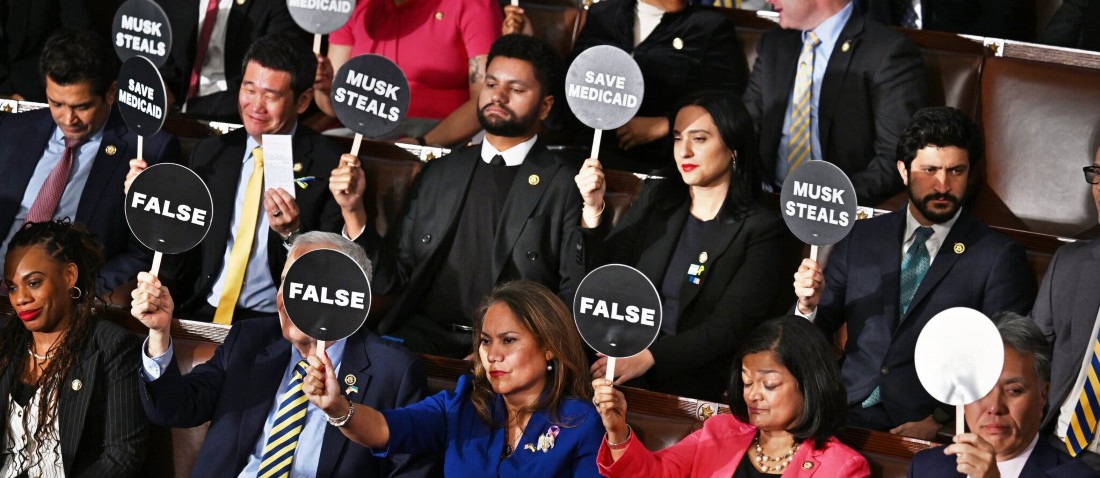
More recently, members have brought printed signs into the chamber during presidential remarks. Messages such as “That’s a Lie”, “Musk Steals”, and “False” have been held up in view of cameras during live broadcasts. These acts transformed what had traditionally been a forum for listening into one for visual confrontation. They also serve as a distraction. “Analysis” of recent State of the Union addresses has focused more on the forms of protest on display during the president’s speech rather than what the president said.
For example, in 2020, then-Speaker Nancy Pelosi tore a copy of President Trump’s speech immediately after he concluded his remarks. The moment, captured live on national television, became one of the most replayed images of that address. Pelosi’s protest stunt is what people remember most about that State of the Union address. It was a breach of institutional respect and Pelosi was celebrated for it.
However, this decline in decorum did not begin with coordinated outfits or torn speeches.
On September 9, 2009, during President Barack Obama’s address to a joint session of Congress on health-care reform, Representative Joe Wilson of South Carolina interrupted the President by shouting, “YOU LIE!” The outburst occurred while the President was speaking and was broadcast live nationwide. People were shocked. It was a stunning display of disrespectful behavior. Most viewers had never seen or heard such an outburst during a State of the Union address.
The chamber reacted immediately. Wilson was formally reprimanded by the House of Representatives. Members of his own party described the remark as inappropriate. He later apologized for the manner and timing of the interruption.
That moment marked a turning point. For more than two centuries, an unwritten rule had governed presidential addresses: members of Congress did not heckle the President from the chamber floor. Disagreement was expected. Public interruption was not. Once that boundary was crossed, the precedent was set.
In the years that followed, interruptions became more frequent and more aggressive. During President Biden’s 2022 address, Representatives Marjorie Taylor Greene and Lauren Boebert repeatedly shouted objections from the chamber floor. In 2023, Greene interrupted Biden again during his remarks on Social Security. In 2024, Republican members interrupted Biden during his comments on immigration policy, prompting direct exchanges between lawmakers and the President.
These incidents demonstrate that the erosion of decorum is not confined to one party. Both Democrats and Republicans have participated in transforming the State of the Union from a formal constitutional duty into a venue for real-time protest and partisan spectacle.
The consequences extend beyond optics. Institutions depend not only on written rules but on shared norms. When those norms weaken, public confidence weakens too. The State of the Union is not a partisan political rally, a debate stage, or a campaign event. It is a constitutional obligation carried out in the people’s House.
Whether Congress will return to a standard of restraint and civility during presidential addresses any time soon remains uncertain. Polarization has deepened. Politicians are increasingly rewarded for confrontation over composure. Yet a restoration of basic decorum would signal institutional maturity and respect for the office of the presidency, regardless of who occupies it.
A renewed commitment to dignity by members of both parties and by presidents themselves would not eliminate disagreement. It would simply reaffirm that some moments in American governance deserve seriousness over spectacle.