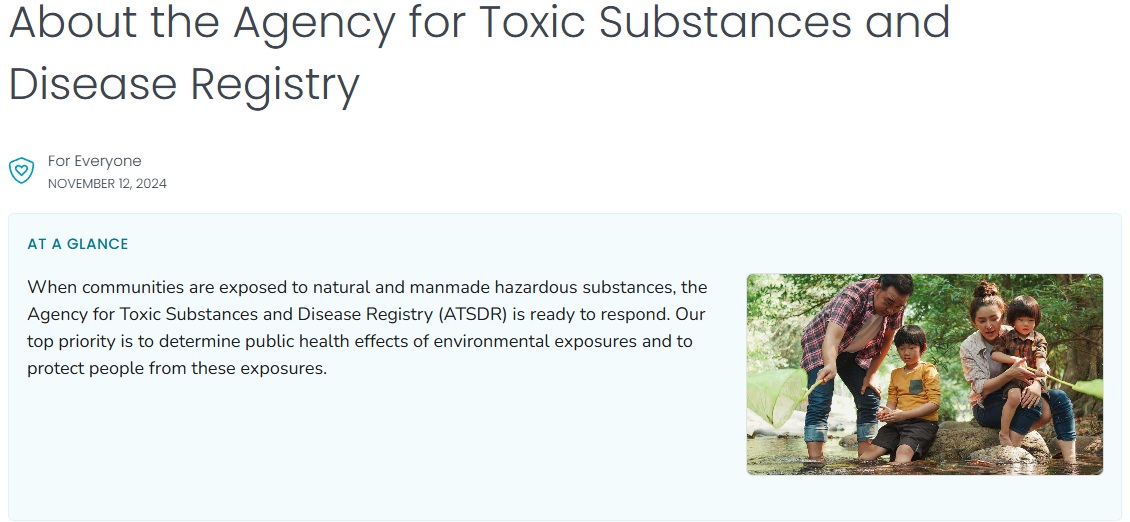
The Agency for Toxic Substances and Disease Registry (ATSDR) identifies environmental hazards. This federal agency operates alongside several other key organizations, such as the Environmental Protection Agency (EPA), the National Institute of Environmental Health Sciences (NIEHS), and the Centers for Disease Control and Prevention (CDC). This raises an important question: How much overlap exists between these four organizations? Would taxpayers be better off if these programs were consolidated? Redundancy within the federal government runs rampantly, costing taxpayers billions of dollars annually.
Understanding the ATSDR
The ATSDR assesses the health effects of hazardous substances and provides guidance on public health issues related to environmental exposures. The ATSDR has an annual budget of approximately $80 million for fiscal year 2025 and around 228 full-time equivalent (FTE) employees. Currently, the ATSDR is the lead federal public health agency for determining, preventing, and mitigating the human health effects of exposure to hazardous substances.
The Role of Other Federal Agencies
While the ATSDR focuses on toxic substances, other agencies also contribute to environmental health:
- Environmental Protection Agency (EPA): Regulates environmental contaminants and sets standards for air and water quality.
- National Institute of Environmental Health Sciences (NIEHS): Investigates how environmental factors affect human health.
- Centers for Disease Control and Prevention (CDC): Addresses a broad range of public health concerns, including those related to toxic substances.
Each agency has its strengths, but overlapping missions can lead to inefficiencies and confusion. This is where the idea of consolidation comes into play.

Potential Benefits of Consolidation
- Increased Efficiency: Merging these agencies could reduce administrative overhead and streamline operations, leading to significant cost savings for taxpayers.
- Improved Coordination: A consolidated agency could enhance collaboration among researchers and public health officials, leading to more effective responses to environmental health issues.
- Focused Resources: Consolidation could allow for better allocation of resources, ensuring funding is directed toward the most pressing public health needs.
Potential Drawbacks of Consolidation
However, the idea of consolidation would be resisted by those people who are satisfied with the status quo whether for political reasons or fear of change. Here are a few arguments those opposed to consolidation might raise:
- Loss of Specialization: Different agencies have specific missions. Merging them could dilute these specializations, potentially leading to less effective interventions.
- Bureaucratic Challenges: Merging agencies can create bureaucratic hurdles and resistance to change, slowing down decision-making.
- Risk of Overlooking Issues: A larger agency might focus on broader issues at the expense of niche areas that require dedicated attention.
Conclusion
The question of whether taxpayers would benefit from consolidating federal environmental health agencies is simple when “Bureaucratic Challenges” are removed from consideration. The benefits, such as increased efficiency and improved coordination, outweigh the drawbacks especially when the national debt has recently topped $37 trillion. The federal government of the United States must cut costs everywhere, not just here and there!
Consolidation can and should occur while at the same time ensuring that public health objectives are met effectively and efficiently. Consolidating the Agency for Toxic Substances and Disease Registry (ATSDR) into the Environmental Protection Agency (EPA) makes sense. Likewise, consolidating the National Institute of Environmental Health Sciences (NIEHS) into the Centers for Disease Control and Prevention (CDC) would be a smart merger.
The consolidations could be inverted because of the similarities found within each organization. Bringing these four organizations together would be the best outcome if they were not just piled on top of one another but dissected and reassembled for optimized service and performance.
For the fiscal year 2025, the National Institute of Environmental Health Sciences (NIEHS) is allocated approximately $800 million from the National Institutes of Health (NIH) budget. When combined with the Agency for Toxic Substances and Disease Registry (ATSDR) 2025 budget of $80 million, significant savings could be achieved for taxpayers through consolidation.
Is it possible to keep the best interests of taxpayers and public health at the forefront simultaneously? Absolutely! Safeguarding the health of communities across the nation by identifying toxic substances and diseases can be accomplished with smaller payrolls and fewer federal government agencies / organizations. It just takes smart, organized people with the will and the skill to do what it takes to get the job done well.
Our national debt is $37 trillion. We must cut costs.
Unpopular and difficult decisions must be made. (14 of 630 in this series) ~ Ed Haas