Conservatives Call for Stronger Action to Protect American Sovereignty and Strategic Interests
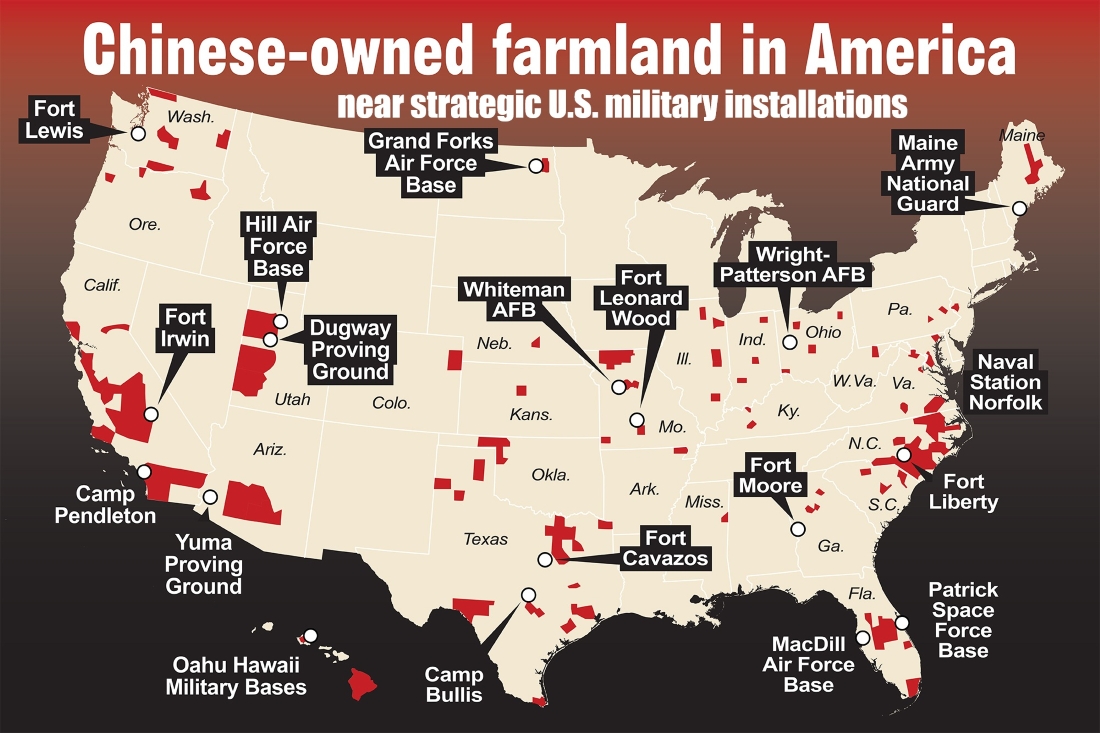
As Chinese companies acquire more American land, especially near sensitive military bases and infrastructure, conservatives across the country are intensifying calls for stricter safeguards to defend U.S. sovereignty and national security. Congressman Dan Crenshaw (R-TX) emphasized, “Allowing foreign entities to purchase land near our military installations is reckless and shortsighted. America must remain vigilant.” Recent acquisitions, including significant Chinese land purchases, have fueled growing anxiety over the intentions of foreign buyers and the potential risks posed to America’s most vital assets.
One of the most notable incidents occurred in 2021, when the Fufeng Group – a Chinese corporation – purchased land alarmingly close to Grand Forks Air Force Base in North Dakota. The purchase drew immediate objections from both local and federal security officials, who questioned the wisdom of allowing foreign entities so near critical defense installations. Senator Kevin Cramer (R-ND) remarked, “This was a wake-up call – our adversaries are using loopholes to plant roots near our most sensitive sites.” Thanks to public pushback and government intervention, the project was ultimately halted, but the episode highlighted a glaring vulnerability in current oversight.
Understanding the Risks of Chinese Land Purchases
The issue of Chinese land purchases has raised alarms among national security experts, who warn that these transactions could lead to increased espionage risks and compromised defense strategies.
Conservatives argue that the concerns go beyond military proximity. China’s significant role as an importer of American agricultural goods, combined with its ownership stakes in U.S. farmland—such as through WH Group’s control of Smithfield—has raised serious questions about the security of America’s food supply. “We must ensure that foreign ownership of farmland does not compromise our ability to feed our people,” said Senator Chuck Grassley (R-IA). While Chinese-held acreage remains just a fraction of all foreign-owned farmland, critics warn that even limited holdings could lead to an unhealthy dependence on foreign interests when it comes to feeding the nation.
There are also real fears about espionage. Chinese land purchased near sensitive sites could be exploited for surveillance, monitoring communications, or gathering intelligence on U.S. military activity. Representative Mike Gallagher (R-WI) cautioned, “We need to close loopholes that allow adversaries to buy up farmland and strategic assets. Our laws must reflect the growing risks to our food supply and military readiness.” Conservatives caution that weak regulations leave the door open to these threats, undermining national security in ways that are difficult to detect and address.
Infrastructure is not immune from these debates. Proposed Chinese-owned renewable energy projects, such as wind farms in Texas, have come under suspicion for their potential to connect with and possibly compromise the U.S. power grid. “National security must come before short-term economic interests,” asserted Senator Tom Cotton (R-AR), “and we should demand transparency and tough restrictions on these kinds of foreign transactions.”
With these issues in the spotlight, the conservative movement is pressing lawmakers to act decisively to close regulatory loopholes, protect critical resources, and ensure that American security and self-sufficiency are never left to chance. As Congressman Mike Waltz (R-FL) concluded, “We cannot afford to be complacent about our sovereignty or our security. The risk is simply too great.”
What is the Committee on Foreign Investment in the United States and why has it failed to block all land purchases from communist China companies?
The Committee on Foreign Investment in the United States (CFIUS) is an interagency panel responsible for reviewing certain foreign investments and acquisitions to determine their potential impact on national security. In practice, CFIUS brings together representatives from the Departments of Treasury, Defense, Homeland Security, and several other agencies, working collectively to assess whether a proposed transaction could give a foreign entity control over a U.S. business or asset in a way that threatens critical infrastructure, sensitive technologies, or access to classified information. While CFIUS has traditionally focused on scrutinizing deals involving technology and defense sectors, the growing complexity of foreign land purchases—especially near strategically important sites—has led many lawmakers to question whether its mandate is broad enough to address emerging risks. This debate underscores the urgent need for reforms that will empower CFIUS to evaluate not just the obvious security threats, but also more nuanced risks posed by foreign ownership of farmland, infrastructure, and other critical assets.
Americans have been very foolish when it comes to Chinese companies purchasing land or operating businesses in the United States. China is a communist country. While on paper it might appear as though Chinese companies are autonomous, they are not. Every business in China is beholden to the state. They are all potential outposts of the communist government.
China is waging unconventional warfare on the United States. It’s well past time for the United States to wake up to some unsettling facts – China is weakening America from within in preparation for something inconceivable. Never forget. In 1998 the FAA had intelligence that a group of unidentified Arab men planned to fly aircraft into the World Trade Center “twin towers”. The assessment was the United States would be able to intercept any such threat over the ocean, before the terrorists reached the mainland.
None of our “intelligence experts” considered that the planes could originate in the United States from Boston Logan International Airport, Dulles International Airport, and Newark International Airport. Have we learned nothing?
“The inferior can defeat the superior.”
~ General Fu Quamyou, chief of staff, China People’s Liberation Army, cited in China Debates the Future Security Environment, National Defense University Press, Washington, D.C.