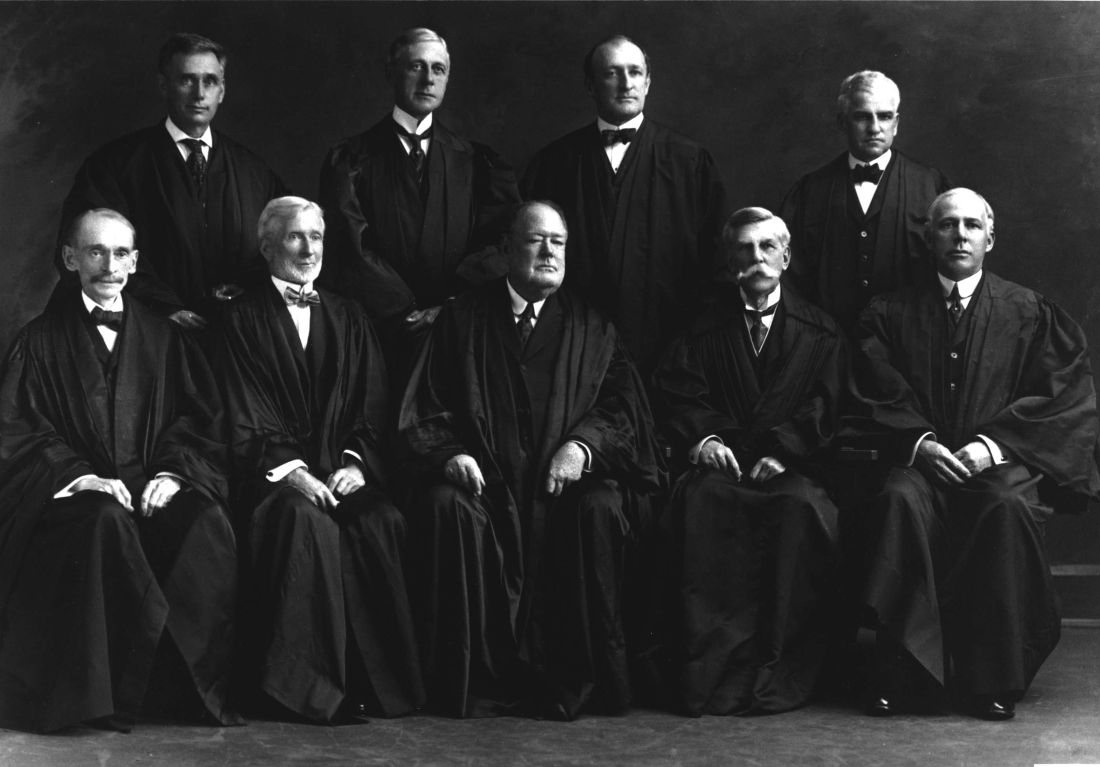
The United States Supreme Court has existed in its current nine-justice form since 1869. It has shaped nearly every aspect of American life, from the right to organize a union to the limits of government surveillance to who may marry. Without exaggeration, it is the most powerful court in human history.
And some Democrats want to pack it!
Before explaining why that idea should alarm Americans of every political stripe, it helps to understand the institution itself. Its history is richer, and far more politically volatile, than many people realize.
The Supreme Court Has Never Been Neutral
One fact surprises many Americans: for most of its modern history, the Supreme Court has leaned conservative. Since 1869, it has been clearly conservative for about 78 years and ideologically mixed for about 47. It has been moderately to strongly liberal for only 32 of the 157 years in which it has had nine justices.
The clearest “liberal court” era was between 1937–1969. This was the only period since the Civil War in which the Supreme Court fundamentally redefined both the relationship between citizens and government and the relationship between the federal government and the states. In 1937 the Supreme Court accepted the constitutional legitimacy of the New Deal order, ushering in an expansion of the federal government.
Although the New Deal began in 1933, the Supreme Court initially struck down several major New Deal programs. The constitutional turning point came in 1937, when the Court stopped resisting broad federal economic regulation. After that, most New Deal-style legislation was upheld, creating the constitutional foundation for the federal government we have today – a modern administrative state.
During the Supreme Court’s “liberal court” era, the size and scope of the federal government expanded dramatically. Whether that expansion was necessary, desirable, or constitutional remains debatable. Federal spending as a share of the economy, federal employment, and the number of federal agencies all increased substantially during this era. What isn’t debatable is the enormous size, scope, and reach of the federal government today is rooted in the rulings that emerged from the Supreme Court when it had a liberal-minded majority.
Democrats Plan to Expand the Court so it Rules like a Liberal Court
The Supreme Court today is solidly conservative with a 6–3 majority. Congressional Democrats do not like it at all. They have used some very harsh rhetoric to criticize the current Supreme Court, particularly after decisions on abortion, administrative power, gun rights, and ethics controversies. The tone ranges from conventional political criticism to accusations that the Court is illegitimate or corrupt.
Here are some notable examples:
- Senator Sheldon Whitehouse has repeatedly argued that the Court has been “captured” by special interests and has described it as suffering from a legitimacy crisis.
- Senator Elizabeth Warren has called the Court “extremist” and said that it is “out of step with the American people.”
- Representative Alexandria Ocasio-Cortez has referred to some decisions as evidence that the Court is acting in a “dangerous” and “anti-democratic” manner and has suggested that impeachment should be considered in response to ethics concerns involving certain justices.
- Senator Richard Blumenthal has described the Court as facing a profound crisis of credibility and has pushed for ethics reforms.
One of the most controversial remarks came from Senate Democratic Leader Chuck Schumer during a 2020 rally outside the Court, when he said that Justices Neil Gorsuch and Brett Kavanaugh would “pay the price” and “won’t know what hit you” if they voted a certain way in abortion cases. Schumer later said he was referring to political consequences, not personal threats, but the remarks were criticized across the political spectrum, including by Chief Justice John Roberts.
Common themes in Democratic criticism have included:
- The Court is “extremist.”
- The Court is “captured” by wealthy interests.
- The Court is “out of touch” with public opinion.
- The Court is “rogue” or “anti-democratic.”
- The Court faces a “legitimacy crisis.”
- Certain justices are ethically compromised.
- It’s Trump’s Court
Republicans, in turn, have accused Democrats of attempting to delegitimize the judiciary because they disagree with the Court’s decisions. Democrats generally respond that they are criticizing judicial philosophy, ethics, and institutional behavior rather than the existence of judicial review itself.
The rhetoric has become considerably sharper in the last decade than it was for most of the post-Warren Court era, reflecting the increasingly polarized nature of American politics.
Several Democratic members of Congress have openly advocated expanding the Supreme Court in order to counter or replace its conservative majority. In 2021, Senator Ed Markey and Representatives Jerrold Nadler, Hank Johnson, and Mondaire Jones introduced the Judiciary Act of 2021, which would have expanded the Court from nine to thirteen justices. They argued that expansion was necessary to “restore balance” after Republicans secured a 6–3 conservative majority. Elizabeth Warren, Tina Smith, Adam Schiff, and Cori Bush later joined efforts to reintroduce similar legislation. Their stated rationale was that the Court had become too conservative and that adding seats was necessary to restore ideological balance and legitimacy.
Nine Justices is Just a Number
The Constitution says nothing about how many justices should sit on the Supreme Court. Congress decides. And for the first eighty years of the republic, Congress kept changing its mind. The Court fluctuated between five and ten justices, almost always for nakedly political reasons.
The number nine was set by the Judiciary Act of 1869, signed by President Ulysses S. Grant. It has remained unchanged for 157 years, not because the Constitution demands it, but because the number of justices has remained acceptable for most. Americans came to regard nine as the right number. Stable. An odd number to avoid ties. Small enough for thoughtful debate.
FDR tried to break that norm in 1937. He wanted to add one new justice for every sitting justice over age 70, potentially expanding the Court to fifteen members. He had just won reelection by a historic landslide. Democrats controlled Congress by enormous margins. And his plan died anyway because enough members of his own party understood that destroying the Court’s independence would cost more than it gained.
That was 89 years ago. Today’s congressional Democrats will tell you they desire to maintain the independence of the Supreme Court so long as the court rules in their favor. These are some special people are they not? Dullards. Every one of them!
The Arms Race Nobody Wins
The argument for expanding the Court today goes like this: Republicans broke the norms first. They refused to hold hearings for Merrick Garland in 2016, an unprecedented blockade of a sitting president’s nominee, then confirmed Amy Coney Barrett just eight days before the 2020 election. The current 6–3 majority is, in this view, the product of procedural theft. Expansion is simply correction.
But the question isn’t whether Democrats have a grievance. The question is whether expansion makes things better or catastrophically worse.
If Democrats add four justices to create a 7–6 liberal majority, what happens the next time Republicans control Congress? They add five more. Then Democrats add six. Within a generation, you could have a 25-member Court whose composition swings with every election cycle, issuing rulings that half the country refuses to recognize as legitimate before the ink is dry.
This is not a slippery slope fallacy. It is the explicit, stated intention of the other side. There is no limiting principle. The Constitution sets no ceiling on the Court’s size. Once the norm breaks, it breaks permanently. The third branch of government would no longer exist. The Supreme Court would no longer be an independent equal power of government.
The Real Danger Isn’t War — It’s the Quiet Collapse of Legitimacy
Some Americans have described Court expansion as a line in the sand; the kind of provocation that could trigger serious civil unrest or worse. An actual civil war on the 1861 model is unlikely. Modern political violence tends not to produce organized armies, territorial secession, or sustained military conflict. The institutions of law enforcement and the military remain, for now, loyal to constitutional order rather than to any faction.
But the scenario that should genuinely alarm us doesn’t require rifles. It requires only that enough Americans decide that federal institutions no longer deserve their obedience.
We are already closer to that precipice than most people want to admit. The Supreme Court’s public approval has been declining for years. January 6th demonstrated that a meaningful number of Americans will resort to violence when they believe institutional outcomes are illegitimate. State governments have already shown willingness to openly defy federal rulings they find politically unacceptable.
A Court that is visibly, nakedly stacked, expanded specifically to deliver a predetermined political outcome, would not be seen as a court at all by a large portion of the American population. It would be seen as a rubber stamp for the political party in power. The historian’s term for what follows is not civil war. It is democratic erosion. The slow, grinding delegitimization of shared institutions until there is no longer enough common ground to hold a republic together. Democracies rarely end with a single dramatic moment. They end with a long accumulation of moments in which trust is spent and never repaid.