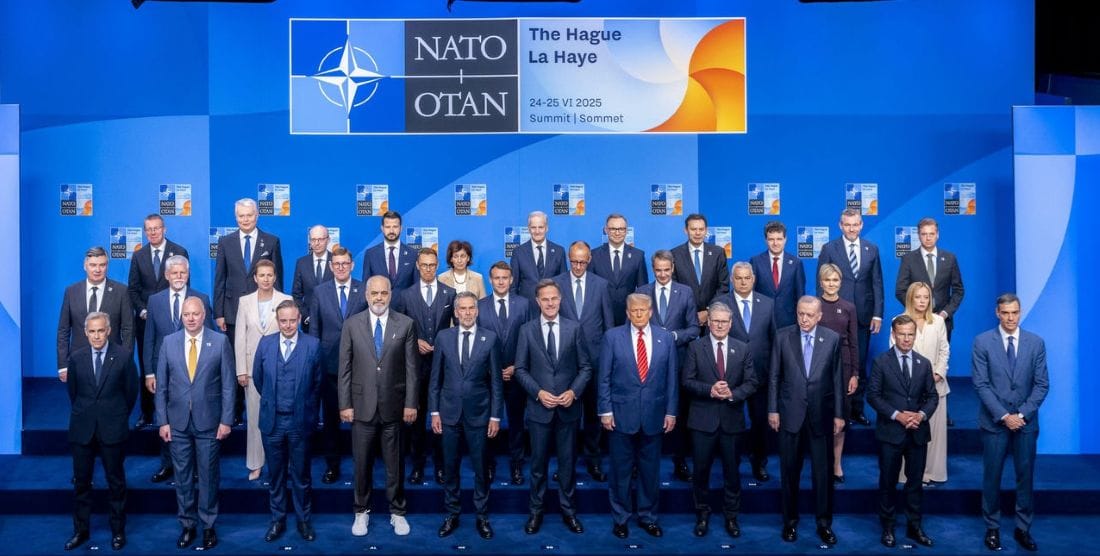
For years, the North Atlantic Treaty Organization has occupied a strange place in American political debate. To some, NATO is one of history’s most successful military alliances, preserving peace in Europe and extending American influence abroad. To others, it is an outdated institution that allows wealthy European nations to rely on American taxpayers for their defense while contributing too little themselves.
As with many foreign policy debates, the truth lies somewhere between those extremes.
President Donald Trump deserves credit for forcing a conversation that many establishment leaders avoided for years: whether America’s NATO allies are carrying their fair share of the defense burden. That question is legitimate, and for too long many European nations did underinvest in their militaries while enjoying the protection of the alliance.
But in reducing NATO to a transactional arrangement – one where nations either “pay up” or risk losing American support – Trump often mischaracterizes what NATO actually is, what it accomplishes, and why it still matters to the United States.
NATO was created in 1949 in the aftermath of World War II, as Western nations sought a unified deterrent against Soviet expansion. At its core is Article 5, the collective defense clause that declares an armed attack against one member to be considered an attack against all.
That principle sounds straightforward, but it is often misunderstood.
Article 5 is not an automatic declaration of war requiring every NATO member to immediately send troops into combat. Rather, it obligates each member nation to respond in a manner it considers necessary, which may include military action but does not require it. That flexibility was intentional, designed to preserve national sovereignty while maintaining collective deterrence.
Equally important is what NATO does not do.
One of the more persistent misconceptions about the alliance is that it serves as a blank check for any military action undertaken by one of its members. It does not.
NATO is a defensive alliance, not an offensive one. If a NATO member were to initiate a war against another country, such as the current military actions by the United States against Iran, alliance membership is not automatically compelled to support the aggression. The treaty is designed to protect members from attack – not to mandate combat support for unilateral military action undertaken by one of its members.
This matters because one criticism often raised by skeptics is that America could be dragged into a reckless conflict started by a smaller allied nation. While diplomatic pressure and geopolitical realities can create complications, NATO itself does not legally obligate collective participation in wars initiated by an aggressor member.
In short, NATO is a shield – not a blank check.
Critics often ask what NATO actually accomplishes today, particularly after the Cold War.
The answer is significant.
Its primary function remains deterrence, particularly against Russia. Moscow’s invasion of Ukraine, while tragic, actually reinforces NATO’s relevance. Ukraine is not a NATO member. Poland is. Estonia is. Latvia is. Lithuania is.
That distinction likely shaped Russia’s calculations.
An attack on a NATO country carries the risk of confrontation not with one nation, but with the combined military and political weight of the alliance, including the United States. Deterrence is difficult to measure precisely because its success often lies in what does not happen.
NATO also provides substantial strategic benefits to the United States that are often overlooked in political rhetoric.
American forces benefit from European basing infrastructure, intelligence sharing, logistics networks, interoperability with allied militaries, and a forward strategic posture that would be far more difficult – and expensive – to maintain unilaterally. NATO is not merely an act of generosity toward Europe. It is also a force multiplier for American power.
Still, Trump’s criticism of European burden-sharing is not without merit.
For years, many NATO nations failed to meet agreed defense spending targets while prioritizing domestic social programs over military readiness. American frustration over that imbalance is understandable. Asking why wealthy nations should depend so heavily on U.S. defense spending is not isolationism; it is a fair policy question.
Trump’s confrontational approach arguably succeeded where gentler diplomacy failed, pushing allies to take defense spending more seriously.
But where his argument falters is in portraying NATO as though it were a subscription service – one where countries that fail to “pay their bills” lose coverage.
That framing may make for effective campaign rhetoric, but it undermines the strategic purpose of the alliance.
Deterrence depends on credibility. If adversaries believe American commitments are conditional or uncertain, the alliance weakens. Russia does not need NATO to collapse outright to benefit; it only needs enough doubt about whether the alliance would hold under pressure.
A strong president can demand greater burden-sharing while still maintaining clear public commitments to collective defense.
That is not weakness. It is strategic discipline.
A serious conservative foreign policy should be neither reflexively interventionist nor reflexively isolationist. It should ask hard questions about cost, accountability, and national interest while recognizing that alliances, when properly managed, can serve American power rather than diminish it.
NATO is imperfect. It is bureaucratic. It can be frustrating.
But it is not the simplistic burden, or the dangerous trap, that some critics suggest.
And it is certainly not a protection racket.